
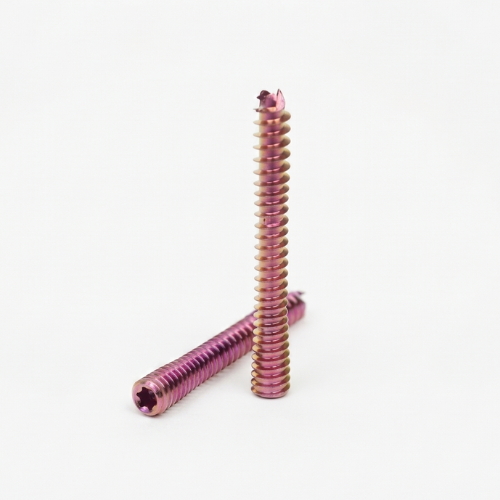
Clinical Indications in Orthopedic Trauma The 4.0mm cannulated headless screw is indicated for trauma reconstruction, osteotomies, non-union stabilization, and joint arthrodesis across medium and small bones:
-
Radial Head & Neck Fractures: Complex Mason Type II and Type III fractures, including coronal shear fractures and split articular fragments where conventional screw heads would cause radiocapitellar or proximal radioulnar joint (PRUJ) impingement.
-
Distal Humerus Articular Trauma: Coronal shear fractures of the capitellum and trochlea (Bryan-Morrey fractures) managed via anterior-to-posterior or posterior-to-anterior headless screw placement.
-
Complex Carpal Trauma & Scaphoid Non-Unions: Large scaphoid non-unions, intercarpal arthrodesis, and trans-scaphoid perilunate fracture-dislocations requiring higher compression loads than smaller-diameter screws provide.
-
Foot & Ankle Trauma: Fractures of the talus (neck and body), calcaneus anterior process, navicular, and cuboid; Akin and scarf corrective osteotomies; and subtalar/talonavicular small-joint fusions.
-
Malleolar & Intra-Articular Avulsions: Tillaux, Wagstaffe, or Volkmann’s (posterior malleolus) articular fragments requiring rigid lag compression without prominent hardware under thin soft tissues.
-
Patellar & Knee Osteochondral Trauma: Fixation of osteochondral fractures of the patella and femoral condyles beneath the articular surface.
